Preprint

BEAT: Balanced Frequency Adaptive Tuning for Long-Term Time-Series Forecasting

Zhixuan Li1, Naipeng Chen1, Seonghwa Choi2, Sanghoon Lee2, Weisi Lin1*

1College of Computing and Data Science, Nanyang Technological University, Singapore

2Department of Electrical and Electronic Engineering, Yonsei University, Korea

*Corresponding author

Overview

Long-term time-series forecasting supports a wide range of applications, including weather prediction and electricity demand planning. Frequency-domain methods address this task by decomposing observations into components that describe temporal variations at different scales. However, separate representations do not by themselves provide an explicit mechanism for adjusting the training emphasis across components. Under a shared forecasting objective, the frequency-specific networks can retain different levels of coefficient prediction error, motivating an error-dependent adjustment to their gradients. To this end, we propose BEAT (Balanced frEquency Adaptive Tuning), a framework that combines frequency-specific error monitoring with adaptive gradient modulation. We design a Frequency-Specific Monitor that compares predicted and target wavelet coefficients in a common normalized space and expresses each discrepancy relative to a reference error computed from the detail components. We further introduce a Dynamical Gradient Balancer that converts these ratios into positive, bounded coefficients. Components with higher relative errors receive larger gradient weights, whereas those with lower relative errors receive smaller weights. A shared modulation-strength parameter controls the departure from unmodulated training, and the monitoring and balancing operations are used only during training. Experiments on seven real-world datasets show that BEAT achieves competitive performance against state-of-the-art forecasting methods.

Error-dependent gradient modulation

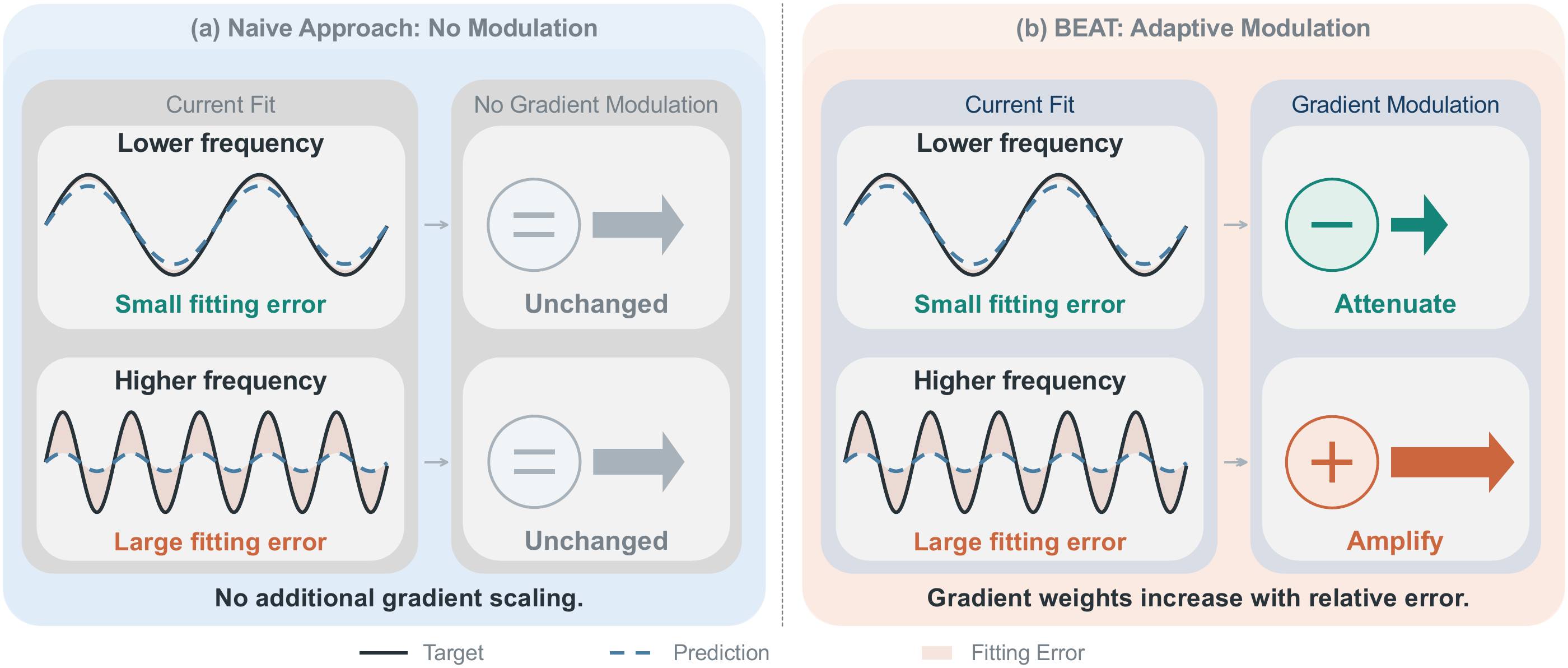
Illustrative comparison of unmodulated training and BEAT's error-dependent gradient modulation
An illustrative case of error-dependent gradient modulation. The two panels show identical target and predicted coefficient series in the same normalized space, rather than experimental results before and after training. (a) The naive approach applies no additional gradient scaling. (b) BEAT attenuates the gradient of the illustrated lower-frequency branch, whose fitting error is below the detail-based reference, and amplifies that of the illustrated higher-frequency branch, whose error is above the reference. The two displayed branches are examples from a multilevel decomposition. Their error ordering is case-specific, not a fixed preference for low or high frequencies. Arrow sizes indicate scaling relative to each branch's own unmodulated gradient, not equal gradient magnitudes across branches.

The Proposed BEAT Method

BEAT forecasting architecture with wavelet decomposition, frequency-specific networks, FSM, and DGB
Overall architecture of BEAT. The forecasting path decomposes historical observations into approximation and detail coefficient series, predicts their future values with frequency-specific networks, and reconstructs the forecast. (a) Wavelet reconstruction using the inverse discrete wavelet transform. (b) Multi-level wavelet decomposition. During training, (c) FSM compares predicted and target coefficients in the same normalized space to obtain relative discrepancy ratios, and (d) DGB converts these ratios into bounded coefficients that modulate the corresponding branch gradients. For clarity, panel (c) omits the target-normalization step Ynorm = 𝒩X(Y) before wavelet decomposition, where 𝒩X is the same history-conditioned RevIN transform used for the input. FSM and DGB are omitted at inference. Best viewed in color and zoomed in.

BibTeX

@misc{li2025beat,
  title={{BEAT}: Balanced Frequency Adaptive Tuning for Long-Term Time-Series Forecasting},
  author={Li, Zhixuan and Chen, Naipeng and Choi, Seonghwa and Lee, Sanghoon and Lin, Weisi},
  year={2025},
  eprint={2501.19065},
  archivePrefix={arXiv},
  primaryClass={cs.LG},
  url={https://arxiv.org/abs/2501.19065}
}